O/L Marking Scheme Sri Lanka: How Examiners Actually Award Marks

Most students treat the O/L marking scheme as an answer key: download it, check whether the answer roughly matches, close the PDF.
It is not an answer key. It is a set of instructions for the examiner who will spend about ninety seconds with your script, telling them which words earn a mark and which earn nothing.
The 2025 O/L was sat by 451,463 candidates in February 2026. Every one of those scripts was marked against a free public document that almost nobody reads properly. Every example below comes from the official 2024(2025) O/L Science marking scheme, English medium.
Four Rules That Decide Your Marks
1. Some Answers Are All or Nothing
Look at the mark column beside this answer on pollination:
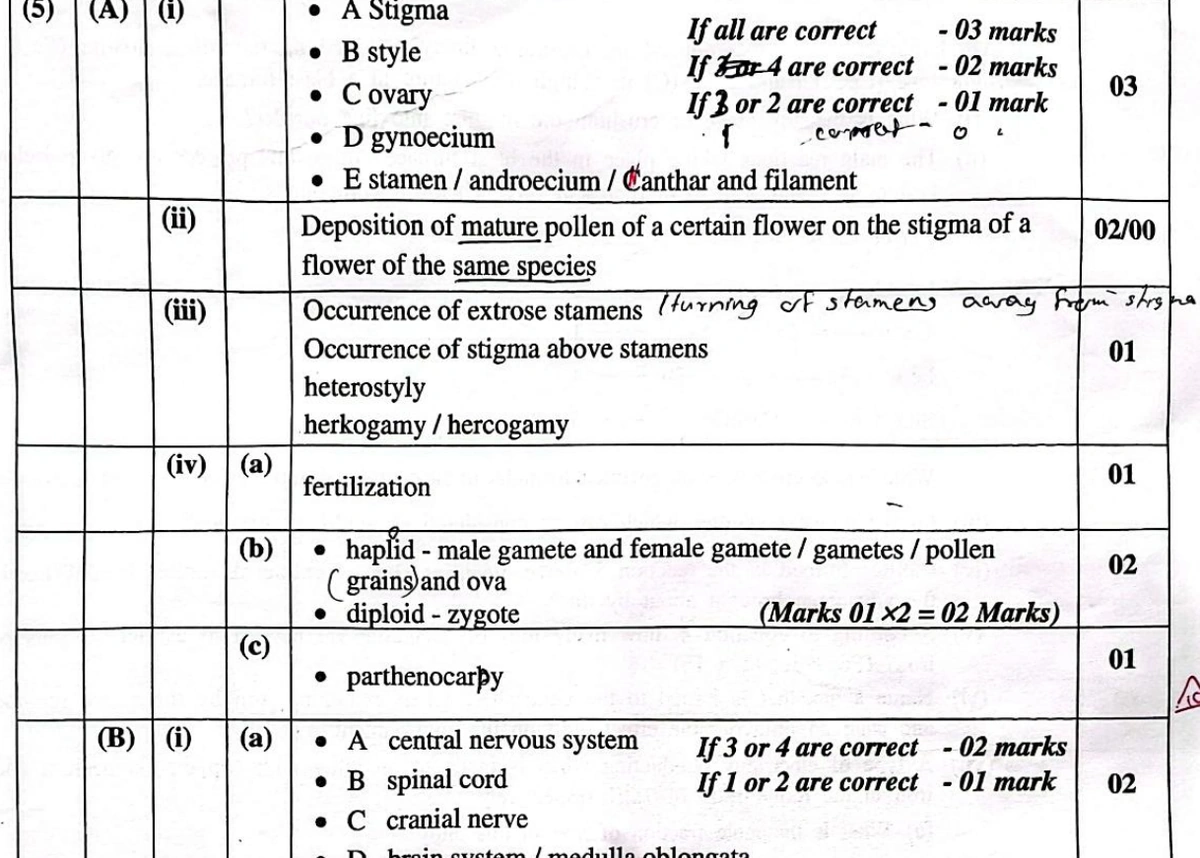
"Deposition of mature pollen of a certain flower on the stigma of a flower of the same species":
02/00
That 02/00 is the examiner's instruction: two marks or zero. There is no one mark for getting close.
Now look at what is underlined in the original: mature, and same species. Those underlines are not decoration. They mark the words the two marks hang on. Write a fluent sentence about pollen landing on a stigma, miss either one, and you score nothing on a question you understood.
It happens again in the chemistry question. Another two-mark answer reads "Because it doesn't ionize fully in water / it partially ionized in aqueous solution", and again, both phrases are underlined in the original. The mark is not for knowing the answer. It is for saying it in the scheme's terms.
Stop reading the marking scheme for meaning. Read it for which words are load-bearing.
 O/L Science marking scheme 2024 excerpt showing all-or-nothing 02/00 marking and banded partial credit
2024(2025) O/L Science marking scheme: the 02/00 column and banded credit.
O/L Science marking scheme 2024 excerpt showing all-or-nothing 02/00 marking and banded partial credit
2024(2025) O/L Science marking scheme: the 02/00 column and banded credit.
2. The Examiner Stops Counting
On the same page, a five-part labelling question is marked like this:
"If all are correct: 03 marks
If 3 or 4 are correct: 02 marks
If 1 or 2 are correct: 01 mark"
Partial credit is real, but banded. Four of five is worth the same as three of five, so if you are stuck on the fifth label, spend the time elsewhere.
The same logic caps generous answers. Elsewhere in the paper, a list of characteristics closes with "(any three)", and a ray diagram is marked "for any two correct rays (02 marks)."
The examiner counts to the number stated and stops. Listing six factors when three are asked earns nothing extra, and any wrong ones sit there inviting a red underline. Writing more is not safer, only slower.
3. Marks Attach to Steps, Not Answers
This is the rule that should change how you write calculations. From the energy question:
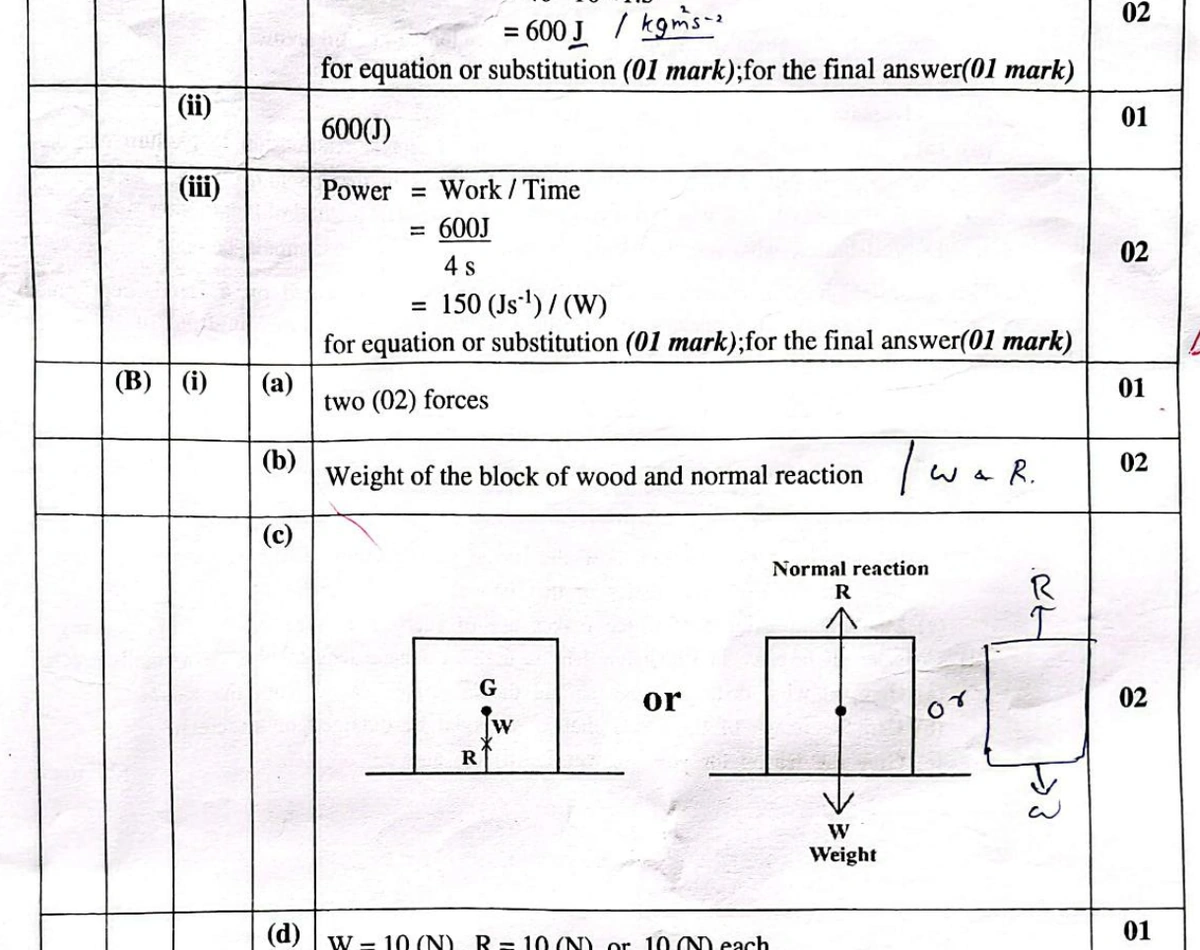
Power = Work / Time
= 600J ÷ 4s
= 150 (Js⁻¹) / (W)
for equation or substitution (01 mark); for the final answer (01 mark)
That instruction appears twice on the page, and a variant appears in the chemistry question: "for correct fraction or final answer 01 mark."
Half the marks are for the equation or the substitution: before you calculate anything. Write the formula, substitute correctly, then fumble the arithmetic, and you still bank a mark. Do it all in your head and write one wrong number, and you bank nothing.
Never erase your working. You are paid for it.
 O/L Science marking scheme 2024 excerpt showing marks for equation or substitution and for the final answer
2024(2025) O/L Science marking scheme: half the marks are for the working.
O/L Science marking scheme 2024 excerpt showing marks for equation or substitution and for the final answer
2024(2025) O/L Science marking scheme: half the marks are for the working.
4. Each Action Is Its Own Mark
Practical questions are marked action by action. A two-mark answer describing a laboratory procedure is broken up like this:
"Dissolve in a (dilute) acid (01 mark)
and filter (01 mark)": 02
Two marks for what most students would write as one short sentence. Blur the two stages together and you may only be credited for one.
The pattern students lose most often is this one:
"for test - (01 mark) ; for observation - (01 mark)"
Name the test and you have half the marks. You need to say what you would see. "Add limewater" is one mark; "add limewater and it turns milky" is two. Labelling questions run on the same principle: an ammeter, a voltmeter and a switch are (01 mark) each.
When a question says how would you identify, answer in two halves: what you do, then what happens.
Where the Scheme Is Generous
Students lose marks to a document that is trying to be fair to them. The 2024(2025) scheme is full of instructions telling examiners to accept variation:
- Alternatives separated by "/":
CO₂ / CO,rheostat / variable resistor / pre-set resistors,by tube feet / swimming. Any one of them earns the mark. - Notation forgiven: "award marks even though the state symbols are missing" and "give marks for symbols drawn also."
- Ideas over wording: "Give marks for the correct idea."
- Open lists: "award marks for methods which retard corrosion" and "Give marks for other suitable answers also."
How far that stretches is worth seeing. One two-mark answer about testing ethanol accepts four completely different experiments, any one of which scores full marks:
"When ethanol is tested with a blue litmus paper, it doesn't turn red / when tested with a pH paper, colour corresponding to pH less than 7 is not given / when methyl orange indicator is added it doesn't turn red / no effervescence is observed when a carbonate is added"
Litmus, pH paper, methyl orange, or a carbonate. The examiner does not care which you chose. You need one correct term and the right idea, not the textbook's exact phrase. Students who freeze trying to recall the "official" wording are losing marks to a rule written to protect them.
How to Revise With a Marking Scheme
Stop using it to check. Start using it to write.
- Attempt the past paper question first: closed book, on the clock.
- Mark your own script like an examiner, point by point in the right margin.
- Highlight the load-bearing words in the scheme's answer, the way the examiner underlines them.
- Circle every mark lost to form rather than knowledge: no working shown, four answers where three were asked, a test named without its observation, a paragraph where separate points were wanted.
- Rewrite the answer in marking-scheme format: short separated points, each visibly worth a mark.
Ten questions of this and your presentation changes permanently.
Marking Scheme vs. Answer Key: What's the Difference?
Most "O/L answers" circulating online are model answers, not marking schemes. They are not the same document, and only one of them tells you where the marks are.
| Feature | Official Marking Scheme | Answer Key / Model Answer |
|---|---|---|
| Purpose | Instructions for the examiner | An answer to compare against |
| Mark allocation | Yes, per sub-step | No |
| Accepted alternatives | Yes, separated by "/" | Usually one wording |
| Shows all-or-nothing questions | Yes (02/00) | No |
| Tells you when marks stop | Yes ("any three") | No |
| Source | Department of Examinations | Tuition notes, websites |
Where to Download Official O/L Marking Schemes
Get them from the source. The Department of Examinations publishes past papers, marking schemes and evaluation reports free at doenets.lk/evaluationreports, by subject and year. Mirror sites host the same PDFs, but check the header reads "Department of Examinations, Sri Lanka".
One caveat: every scheme is stamped "amendments to be included," because chief examiners can adjust it at the marking conference. These documents show you the standard; they are not a contract for disputing a result.
Frequently Asked Questions
Are marking schemes on past-paper websites official?
Most are direct copies of the Department of Examinations PDFs. Check for the header and subject code on page one.
Do I lose marks for answering more questions than required?
Not directly, but the examiner writes off your lowest-scoring answers. You lose the time, not the marks.
Do I have to use the exact wording in the marking scheme?
No. Terms separated by a forward slash are alternatives, and any one earns the mark.
Is the O/L syllabus changing?
The new curriculum reaches Grade 10 in 2028, and the first O/L under it is 2029. Until then the current paper structure and marking conventions hold.
Conclusion: Practise Answers the Way They Are Marked
Knowing the rules is one thing. Building the habit of separated points, visible working and load-bearing keywords takes repetition on real questions.
BrainUs AI answers structured questions in marking-scheme style: the formula, then the substitution, then the final answer with its unit: the exact sequence the examiner pays for. Every answer cites the textbook it came from, so you can open the book and check it yourself. BrainUs Learn holds the past papers to practise on.
Take one past paper question tonight and mark it yourself like an examiner. The gap you find will be the easiest one you ever close.
Ready to practise structured answers? Visit BrainUs AI and start writing answers the way they are marked.
Ready to experience BrainUs AI?
Join thousands of Sri Lankan students who are already learning smarter with AI-powered education.